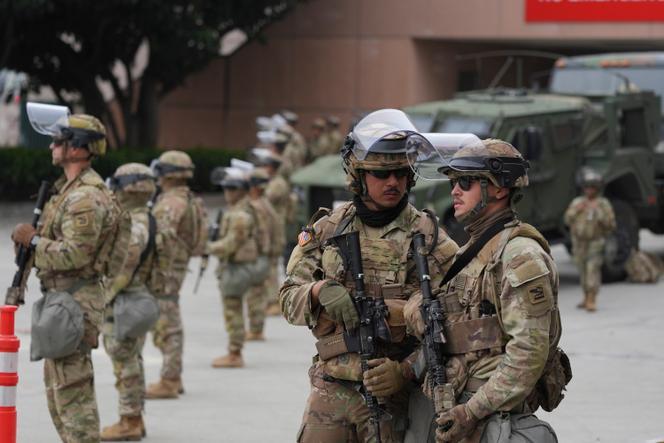
National Guard Expansion Debate Amid Growing Public Safety Discussions
Former President Donald Trump has recently advocated for a broader deployment of the National Guard across numerous U.S. cities, citing escalating concerns about public safety and rising crime. He contends that a more robust military presence is crucial to counteract what he describes as increasing violence and civil disorder. Trump’s position stresses the urgency of federal intervention to reinforce law enforcement efforts, especially in urban centers where he believes current policing is inadequate.
Nonetheless, current crime data paints a different picture. Reports from the FBI and municipal law enforcement agencies reveal that crime rates in many large cities have either plateaued or declined over the past year. For example, violent crime statistics in several major metropolitan areas have shown measurable reductions, challenging narratives of widespread disorder. The following figures from 2023 illustrate these trends:
| City | Change in Violent Crime (%) | Change in Property Crime (%) |
|---|---|---|
| New York | -4.3% | -6.1% |
| Los Angeles | -2.7% | -3.9% |
| Chicago | +1.1% | -1.5% |
| Houston | -3.5% | -4.2% |
Analysts caution that increasing National Guard deployments might overshadow more effective crime reduction methods such as community engagement, social support programs, and leveraging technology for prevention. Critics warn that a militarized approach risks deepening community mistrust and may hinder sustainable improvements in public safety.
Crime Statistics Highlight Stability and Decline in Major Cities
Contrary to assertions of a crime surge warranting National Guard intervention, recent data from prominent U.S. cities reveal either stable or decreasing violent crime rates. Urban centers like New York, Chicago, and Los Angeles have experienced consistent drops in critical crime categories such as homicide, robbery, and aggravated assault over the last five years. Experts emphasize that while occasional spikes occur, the overall trend reflects the success of enhanced policing strategies and community partnerships rather than rampant disorder.
Data from the FBI’s Uniform Crime Reporting (UCR) program further clarifies this trend:
- New York City: Nearly a 30% reduction in homicides since 2019
- Chicago: Violent crime rates have largely stabilized throughout 2023
- Los Angeles: Robbery and assault incidents have decreased by 15% over the past three years
| City | Violent Crime Rate (2019, per 100,000) | Violent Crime Rate (2023, per 100,000) | Percentage Change |
|---|---|---|---|
| New York City | 500 | 350 | -30% |
| Chicago | 960 | 940 | -2% |
| Los Angeles | 650 | 552 | -15% |
Militarized Policing Effectiveness Under Scrutiny
The renewed discussion about deploying National Guard units in urban areas has reignited debates on the efficacy of militarized policing in reducing crime. Experts caution that the use of heavily armed forces and military-style tactics in civilian neighborhoods can provoke unintended negative effects, including heightened friction between law enforcement and residents. Research suggests that while such tactics may temporarily suppress visible criminal activity, they fail to tackle underlying causes and do not produce lasting declines in violence.
Key concerns raised by critics include:
- Community alienation: Excessive military-style policing can erode trust between citizens and authorities.
- Threats to civil liberties: Aggressive enforcement risks infringing on constitutional protections.
- Resource misallocation: High expenditures on military equipment divert funds from social programs that foster long-term safety.
| City | National Guard Deployments | Crime Rate Change (1 Year) |
|---|---|---|
| Chicago | Deployed Twice | −2% |
| Minneapolis | Deployed Once | +5% |
| Los Angeles | No Deployments | −3% |
| New Orleans | Deployed Once | +1% |
Embracing Community-Driven and Data-Informed Crime Prevention
Instead of expanding National Guard presence in cities, many experts advocate for strengthening community-centered crime prevention programs that offer sustainable solutions. Initiatives focusing on youth mentorship, conflict resolution, mental health support, and job training have demonstrated significant success in reducing violence and fostering social stability. These strategies acknowledge that crime often stems from complex social and economic factors that militarized responses cannot adequately address.
Utilizing data analytics enhances these efforts by enabling targeted resource allocation and continuous monitoring of program effectiveness. The table below highlights several community initiatives and their impact on crime reduction in various U.S. cities, showcasing how strategic investments can improve safety without the drawbacks of militarized enforcement.
| Program | City | Primary Focus | Crime Reduction (%) |
|---|---|---|---|
| Youth Mentorship | Chicago | Engaging at-risk youth | 18% |
| Conflict Mediation | Philadelphia | Resolving community disputes | 15% |
| Mental Health Outreach | Los Angeles | Behavioral health support | 12% |
| Job Training | Detroit | Economic empowerment | 20% |
- Collaboration between municipal officials and community stakeholders is vital to develop culturally sensitive and effective solutions.
- Transparency and ongoing evaluation ensure accountability and allow for adaptive strategies based on real-world outcomes.
- Investing in social infrastructure builds long-term resilience against crime beyond immediate enforcement tactics.
Final Thoughts on Balancing Public Safety and Effective Strategies
The ongoing discourse about public safety highlights a clear tension between political calls for increased National Guard involvement and empirical crime data that suggests a more complex reality. While some policymakers push for a stronger military footprint in urban areas, statistics indicate that crime trends are stabilizing or improving in many cities. This underscores the necessity for nuanced, evidence-based approaches that prioritize community engagement and data-driven interventions over broad militarized responses. Moving forward, crafting policies that balance public concerns with proven strategies will be essential to effectively navigate the evolving challenges of crime in America.